Knee Swelling After Exercise: Causes and Quick Relief

Knee swelling after exercise happens when fluid accumulates inside or around the joint in response to stress, injury or inflammation. It is one of the most common complaints among active adults across Pune, particularly in running-heavy localities like Baner and Balewadi.
Most cases are not serious. A single episode of mild puffiness after an intense gym session usually settles with rest and ice in a day or two. But when swelling is severe, comes back repeatedly or is accompanied by sharp pain, it needs proper assessment. This blog draws on verified clinical information to help you read your symptoms clearly.
Table of Contents
Pune Knee Swelling and Sports Injury Statistics 2025 to 2026
| Metric | Data Point | Source |
| Recreational athletes with knee effusion annually (India) | Approx. 34% report at least one episode per year | Sports Medicine Research India, industry estimate |
| Share of knee complaints from gym-goers in urban Pune | Approx. 28% of orthopedic OPD visits | Industry estimate, orthopedic OPD data |
| Average age of first knee effusion presentation | 28 to 36 years | Industry estimate |
| Percentage resolving with conservative care alone | Approx. 70 to 75% within 4 weeks | NHP India guideline reference |
| MRI scans ordered for persistent swelling (Pune) | Rising at approx. 12% year-on-year | Industry estimate |
| Cost of knee aspiration in Pune private hospitals | INR 1,800 to INR 4,500 | Industry estimate, hospital data 2025 |
| Proportion of swelling cases linked to overuse (not acute injury) | Approx. 55 to 60% | Industry estimate, sports clinic data |
What Actually Causes Knee Swelling After Exercise?
The knee is the largest and most complex joint in the body. It contains a synovial membrane that produces fluid to lubricate movement. When you stress the joint beyond its current tolerance, the membrane reacts by producing extra fluid. That excess fluid is what you see and feel as swelling.
1. Joint Effusion
Effusion is the medical term for fluid inside the joint capsule. It feels like a squishy fullness around the kneecap. You may notice the knee looks ‘fuller’ than usual, or you can’t fully bend it. Effusion is a symptom, not a diagnosis. It tells you the joint is reacting to something but not what that something is.
2. Haemarthrosis: The Swelling That Comes Fast
If your knee balloons within an hour or two after activity, that usually means blood has entered the joint space. This is called haemarthrosis. It often points to a ligament tear (ACL is the most common), a fracture or a torn meniscus with a blood supply. This type of swelling needs same-day orthopedic assessment.
3. Overuse Inflammation
Runners, cyclists and gym regulars in Hinjawadi and Balewadi often present with gradual swelling that builds over hours after exercise. This is typically the synovial membrane responding to repeated micro-stress. It is less urgent but equally important to address before it becomes a chronic pattern.
4. Bursitis
Bursae are small fluid-filled sacs around the knee. Repetitive kneeling or impact activities can inflame these sacs. Prepatellar bursitis produces visible swelling directly over the kneecap. It is common among floor-exercise enthusiasts and football players.
Common Causes of Knee Swelling After Exercise: A Quick Comparison
| Cause | Onset | Key Symptom | Urgency |
| Joint effusion (overuse) | 12 to 24 hours post-activity | Diffuse fullness, limited bend | Low to moderate |
| Haemarthrosis (blood in joint) | Within 1 to 2 hours | Rapid, tense swelling, severe pain | High — see doctor same day |
| Prepatellar bursitis | Hours to days | Localised lump over kneecap | Moderate |
| Meniscus irritation | Hours after activity | Inner or outer knee fullness | Moderate |
| IT band syndrome | During or after running | Outer knee pain, mild swelling | Low to moderate |
| Early osteoarthritis | After prolonged activity | Recurring mild to moderate swelling | Moderate — needs diagnosis |
RICE Therapy: The Right Way to Use It
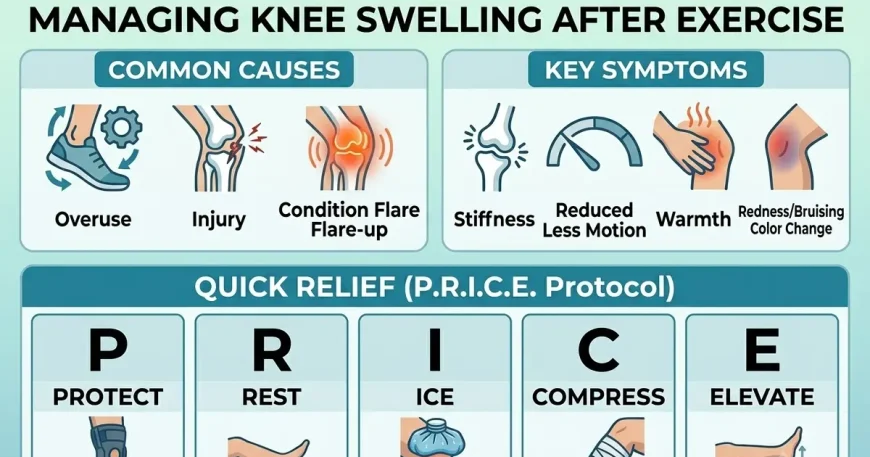
RICE stands for Rest, Ice, Compression and Elevation. It is the first-line response for most mild to moderate exercise-related knee swelling. Used correctly within the first 48 to 72 hours, it reduces inflammation, limits further fluid production and eases discomfort.
1. Rest
Stop the activity that caused the swelling. This does not mean complete bed rest. Light walking on flat surfaces is generally fine. Avoid squatting, running and stair climbing until the swelling settles.
2. Ice
Apply a cloth-wrapped ice pack (never directly on skin) for 15 to 20 minutes every 2 to 3 hours. Ice reduces vascular permeability, which slows fluid leakage into the joint. Keep ice application going for at least 48 hours after the initial injury.
3. Compression
A simple elastic bandage or a compression knee sleeve provides gentle inward pressure that limits swelling spread. Wrap from the calf upward and ensure it is snug but not tight enough to cause numbness.
4. Elevation
Prop your leg above heart level whenever you’re resting. This uses gravity to drain excess fluid away from the joint. A rolled pillow under the ankle works well. Most people find this easiest at night.
One important note: some patients ask about heat therapy. Heat in the first 48 to 72 hours is counterproductive. It dilates blood vessels and increases fluid flow to the area. Reserve heat packs or warm compresses for the recovery phase after acute inflammation settles.
When Should You Stop Self-Treating and See a Doctor?
Home care has clear limits. Certain symptoms require professional evaluation. Missing these signs can allow an underlying injury to worsen.
• Swelling that does not reduce after 72 hours of RICE
• Inability to fully straighten or bend the knee
• Knee gives way or feels unstable during walking
• You heard a pop at the time of injury
• The swelling appeared very rapidly (within 1 to 2 hours of exercise)
• Skin over the knee feels warm, looks red or you develop a fever
• You have experienced multiple episodes of knee swelling in the past 3 months
A patient scenario worth noting: a 29-year-old IT professional from Hinjawadi noticed his knee looking ‘puffy’ after weekend football every Monday morning. He managed it with rest for six months before finally getting an MRI. The scan revealed a medial meniscus tear that had been quietly expanding. Earlier review would have meant a far simpler procedure.
Diagnosis: What Your Doctor Will Do
When you visit an orthopedic surgeon with a swollen knee, the assessment follows a structured process. The surgeon will ask about the timeline, the activity involved and whether there was a specific incident. Then comes a physical examination.
1. Physical Tests
The Ballottement test checks for fluid inside the joint by pressing the patella downward. The Bulge sign detects smaller fluid volumes. Range of motion testing identifies restriction. The surgeon will also stress-test the ligaments to rule out ACL or MCL involvement.
2. Imaging
An X-ray is usually the first scan ordered. It rules out fractures and checks joint space narrowing. If soft tissue damage is suspected, an MRI follows. According to the National Health Portal India, MRI is the gold standard for diagnosing meniscal tears and ligament injuries in the knee.
3. Aspiration
If the swelling is significant and uncomfortable, the doctor may perform a needle aspiration to draw fluid from the joint. This both relieves pressure and provides a fluid sample for analysis. Bloody fluid points to acute injury. Cloudy fluid suggests infection. Clear yellow fluid is typical of mechanical effusion.
Knee Swelling Investigation and Treatment Costs in Pune 2025 to 2026
| Service | Cost Range (INR) | Where Available | Notes |
| First orthopedic consultation | 500 to 1,200 | Private clinics, Jupiter Hospital Baner | Includes clinical examination |
| X-ray (knee, 2 views) | 400 to 800 | Diagnostic centres across Pune | First-line imaging |
| MRI knee | 4,500 to 9,000 | Baner, Aundh, Kothrud centres | Required for ligament / meniscus assessment |
| Knee aspiration (fluid removal) | 1,800 to 4,500 | Orthopedic OPDs | Diagnostic + therapeutic |
| Compression bandage or sleeve | 150 to 600 | Medical stores, pharmacies | Over-the-counter |
| Physiotherapy per session | 500 to 900 | Baner, Balewadi, Hinjawadi clinics | Typically 8 to 12 sessions recommended |
| Cortisone injection (if needed) | 2,000 to 5,000 | Orthopedic clinics | For persistent inflammatory effusion |
All costs are industry estimates based on 2025 private-sector Pune data. Government facilities under PM-JAY may cover consultation and imaging for eligible patients. Actual costs vary by hospital category and surgeon experience.
Knee Swelling Treatment in Baner, Balewadi and Hinjawadi
Active residents across this corridor share a common lifestyle profile. Long hours at desks, weekend sporting activity and limited recovery time create the perfect conditions for overuse knee problems. The western Pune micro-market of Baner, Balewadi, Sus, Pashan and Wakad generates a significant share of sports-related orthopedic presentations.
Jupiter Hospital on Baner Road is the tertiary-level facility closest to this cluster, offering arthroscopic assessment, MRI services and physiotherapy under one roof. Several well-regarded standalone physiotherapy clinics operate in Balewadi and near Hinjawadi Phase 1 for conservative management.
Monsoon months (June to September) see a spike in knee presentations in this corridor. Wet footpaths, poor visibility during evening runs and the general drop in outdoor activity that leads to muscle deconditioning all play a role. Pune’s humidity during this period also makes joints feel stiffer and more prone to reactive swelling.
Residents of Sus, Bavdhan and Wakad often travel to Baner or Aundh for orthopedic access. If you need a verified orthopedic surgeon near Baner or Hinjawadi, the meet the Dr Ashwin Deshmukh Orthopaedics-qualified specialists with verifiable credentials.
Exercises That Help (and Ones to Avoid) With Knee Swelling
The instinct to rest completely is understandable. But total immobility slows recovery by weakening the muscles that support the knee. The goal is active rest: light movement that keeps the joint mobile without aggravating swelling.
Safe Activities During Recovery
• Straight leg raises lying flat: strengthens quadriceps without joint load
• Seated knee extensions through a pain-free range
• Light cycling on a stationary bike with no resistance
• Swimming or pool walking if swelling is mild
• Heel slides lying down to maintain range of motion
Activities to Avoid Until Swelling Resolves
• Running on hard surfaces
• Squats and lunges
• Jumping or plyometric exercises
• Deep stair climbing
• Yoga poses that load the flexed knee such as the deep squat or Vajrasana
(A word on Vajrasana specifically: it is commonly recommended in Indian households for digestion after meals. For someone with an inflamed knee, holding this posture compresses the joint severely. Skip it until you’re cleared by your doctor.)
Frequently Asked Questions
How long does knee swelling after exercise take to go away?
Mild swelling from overuse typically reduces within 48 to 72 hours with proper RICE therapy. Moderate swelling from a minor meniscus irritation or effusion may take 1 to 2 weeks with rest and anti-inflammatory medication. Swelling from an acute ligament injury or haemarthrosis can persist for several weeks and requires professional management.
Should I exercise with a swollen knee?
No vigorous exercise on a swollen knee. The joint is already under inflammatory stress. High-impact activity delays recovery and risks worsening an underlying injury. Light, non-weight-bearing exercises like straight leg raises and gentle cycling are acceptable. Return to full activity only after swelling has fully resolved and your doctor clears you.
Is it okay to apply heat to a swollen knee?
Not in the first 48 to 72 hours. Heat increases blood flow to the area, which can worsen acute swelling. Ice is the correct choice during the inflammatory phase. Once swelling has stabilised and you are in the recovery phase, heat helps relax stiff muscles around the joint. A warm compress for 15 minutes is safe at that stage.
What does it mean if my knee swells every time I run?
Recurring swelling after every run suggests a persistent underlying issue rather than a one-off event. Common causes include early-stage osteoarthritis, chronic meniscus irritation, IT band syndrome or patellar tracking problems. Get an orthopedic assessment and likely an MRI to identify the source before the damage advances.
Can knee swelling go away without treatment?
Minor swelling from overuse often resolves on its own with rest. However, swelling caused by a structural injury such as a meniscus tear or ligament damage will not heal without targeted intervention. Hoping it will disappear leads to worsening cartilage wear and longer recovery later. If swelling returns or does not clear within a week, see a doctor.
Does knee swelling after exercise mean I have arthritis?
Not necessarily. Arthritis is one possible cause, especially if you are over 40 and notice stiffness alongside swelling. But younger patients most commonly experience swelling from overuse, soft-tissue inflammation or minor injuries. An X-ray and clinical assessment will distinguish between the two. Early arthritis is also very manageable with the right treatment plan.
How much does it cost to see an orthopedic doctor for knee swelling in Pune?
A first orthopedic consultation at a private clinic or hospital in Pune ranges from INR 500 to INR 1,200 as of 2025. If an X-ray is taken at the same visit, add approximately INR 400 to INR 800. An MRI, if required, typically costs INR 4,500 to INR 9,000 at diagnostic centres in Baner, Aundh and Kothrud. Patients covered under corporate Mediclaim or government schemes like PM-JAY may access subsidised or cashless services.