What Happens During a Diagnostic Arthroscopy? Complete Guide

what happens during diagnostic arthroscopy, the surgeon makes one or two small cuts around the joint, inserts a thin camera called an arthroscope and views the joint directly on a screen. It is usually a day-care procedure under general or regional anaesthesia, and most patients go home the same day. If a treatable problem is found during the look, it can often be repaired in the same sitting. This guide reflects how verified orthopedic surgeons in Pune perform and explain diagnostic arthroscopy. Anxious about the procedure? Here’s exactly what happens.
Pune Diagnostic Arthroscopy Statistics 2025 to 2026
These figures set clear expectations.
| Metric | Figure | Source |
| Typical procedure duration | 30 to 60 minutes | Industry estimate, clinical practice |
| Hospital stay | Usually day-care | Industry estimate |
| Anaesthesia type | General or spinal, as advised | Clinical practice |
| Arthroscopy cost range, Pune | INR 54,000 to 1,20,000 | Industry estimate, Pune hospitals |
| Return to light activity | Often within a few days | Published research |
| Concurrent treatment in same sitting | Frequently possible | Clinical practice |
Figures marked Industry estimate are practical ranges, not official statistics.
Quick Facts
- An arthroscope is a pencil-thin camera inserted through a small cut.
- Most diagnostic arthroscopies are day-care procedures.
- The surgeon views the joint live on a monitor.
- Repairs can often be done through additional small cuts.
- Recovery is usually faster than open surgery.
What Is a Diagnostic Arthroscopy and Why Is It Done?
A diagnostic arthroscopy is a keyhole procedure that lets the surgeon look directly inside a joint. Scans like MRI are powerful, but sometimes they don’t show everything clearly. A direct look inside the joint, with a camera, resolves the uncertainty.
It’s most often used for the knee, shoulder and hip. Common reasons include unexplained pain, suspected cartilage or meniscus damage, and persistent symptoms that don’t match scan findings. The advantage is obvious: instead of guessing, the surgeon sees.
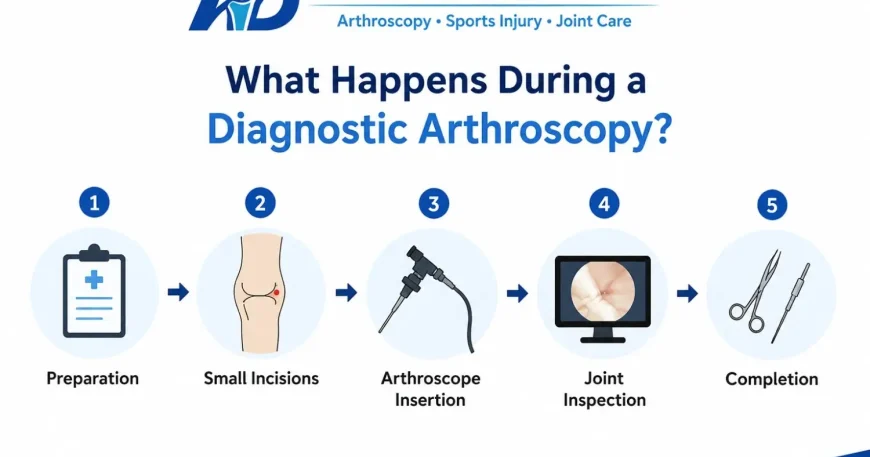
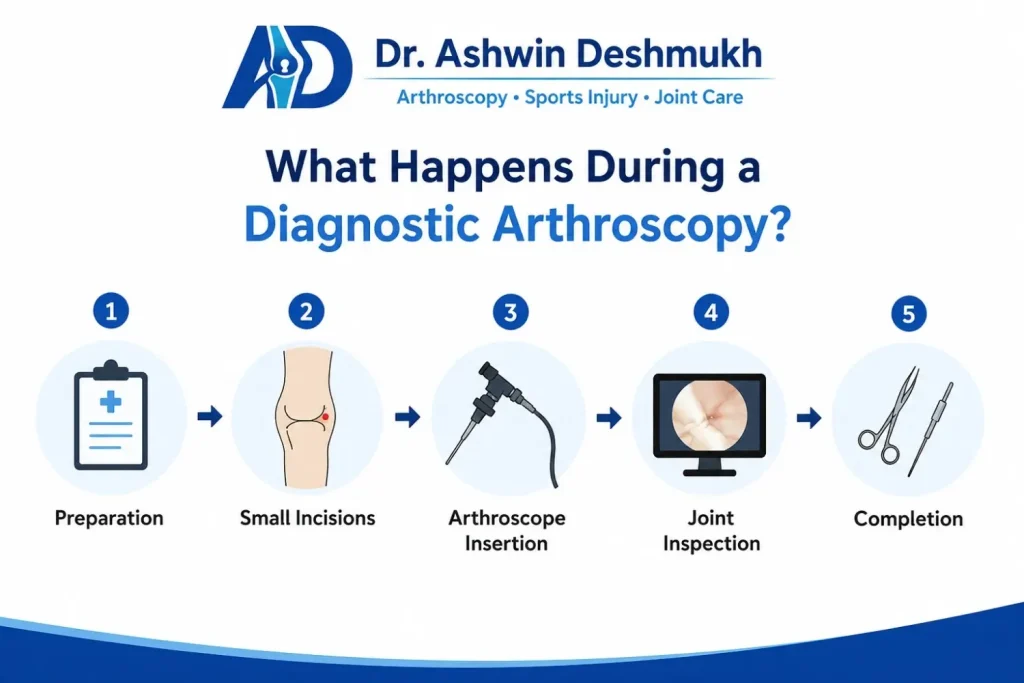
Step by Step: What Happens During Diagnostic Arthroscopy
Here’s the procedure from start to finish.
| Stage | What Happens | Typical Duration |
| Pre-op preparation | Consent, anaesthesia, positioning | 30 to 60 minutes |
| Anaesthesia | General or regional, as planned | 15 to 30 minutes |
| Portal creation | 1 to 2 small cuts around the joint | A few minutes |
| Inspection | Camera inserted, joint viewed on screen | 20 to 40 minutes |
| Repair if needed | Additional cuts for instruments | Varies by finding |
| Closure and dressing | Small stitches or strips, dressing applied | 10 minutes |
Step 1: Preparation and anaesthesia
You arrive at hospital having fasted. The anaesthetist reviews your health, and you receive either general anaesthesia (asleep) or a regional block (numb but awake). Both are common and safe.
Step 2: Portals
The surgeon makes one or two small cuts, called portals, around the joint. These are usually under a centimetre each. A clear fluid is then run into the joint to expand the space and improve visibility.
Step 3: Inspection
The arthroscope, a thin tube with a camera at the tip, is guided into the joint. The surgeon views every structure on a high-definition screen, checking cartilage, ligaments, the joint lining and any damage.
Step 4: Treatment if possible
If a treatable problem is found, the surgeon inserts small instruments through an additional portal and fixes it on the spot. Many meniscus trims, cartilage smoothings and loose-body removals happen this way.
Step 5: Closure and discharge
The portals are closed with a stitch or tape strip and covered with a small dressing. Most patients rest in recovery for an hour or two and then go home the same day.
What to Expect After the Procedure
Recovery from a straightforward diagnostic arthroscopy is usually quick. The small incisions cause far less discomfort than open surgery.
- Mild soreness and swelling around the joint are normal for a few days.
- Most patients manage with simple pain relief.
- Light activity often returns within days.
- If a repair was done, recovery follows that procedure’s timeline.
- Follow-up is usually within one to two weeks to review findings.
A 45-year-old teacher from Aundh had months of unexplained knee pain that scans couldn’t explain clearly. Diagnostic arthroscopy revealed a small cartilage flap. It was trimmed in the same sitting. She walked out the same evening and was back at work in three days. The procedure gave her both the diagnosis and the fix.
Diagnostic vs Therapeutic Arthroscopy: The Difference
These two terms often cause confusion.
- Diagnostic arthroscopy: the primary goal is to look inside and identify the problem.
- Therapeutic arthroscopy: the primary goal is to treat a known problem.
- In practice, the two often combine. A diagnostic look frequently becomes a therapeutic repair if something treatable is found.
Diagnostic Arthroscopy in Baner and Across Pune
Pune has experienced arthroscopic surgeons like Dr. Ashwin deshmukh and modern day-care facilities across the city, with west Pune especially well served.
If you live in Baner, Balewadi, Aundh, Wakad or Pashan, arthroscopy in this belt generally costs between INR 54,000 and 1,20,000, with day-care facilities that let you recover at home the same evening. A verified arthroscopy consultation in Baner can guide whether diagnostic arthroscopy is the right next step for your joint.
A local note. Many Pune patients worry unnecessarily about arthroscopy after reading about it online. The reality is far gentler than open surgery. Most people are surprised by how straightforward the day turns out to be.
Frequently Asked Questions
What happens during a diagnostic arthroscopy?
During a diagnostic arthroscopy, the surgeon makes one or two small cuts around the joint, inserts a thin camera to view the joint on a screen and inspects all structures directly. If a treatable problem is found, it can often be repaired in the same sitting.
Is diagnostic arthroscopy a day-care procedure?
Yes. Diagnostic arthroscopy is usually a day-care procedure, with most patients going home the same evening after a short recovery period. A longer stay is only needed if a more complex repair is performed.
Does diagnostic arthroscopy hurt?
You will not feel anything during the procedure, as it is done under general or regional anaesthesia. Mild soreness and swelling around the small cuts are normal for a few days afterwards and are managed with simple pain relief.
How long does a diagnostic arthroscopy take?
A typical diagnostic arthroscopy takes around 30 to 60 minutes, depending on the joint and what is found. Additional time is needed if a repair is carried out in the same sitting.
What is found during a diagnostic arthroscopy?
A diagnostic arthroscopy can reveal cartilage damage, meniscus tears, ligament problems, loose bodies, synovitis or other joint issues that scans may not have shown clearly.
How long is recovery after diagnostic arthroscopy?
Recovery from a simple diagnostic arthroscopy is usually quick. Light activity often returns within a few days. If a repair was also done, recovery follows that procedure’s specific timeline.