Is Arthroscopic Surgery Painful? Dr. Ashwin Deshmukh Honest Answer

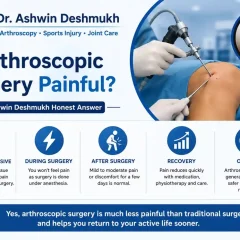
Arthroscopic surgery is not considered a painful procedure. It is performed under regional or general anaesthesia so patients feel nothing during the operation. Post-operative discomfort is typically mild to moderate, managed with standard pain medication, and resolves within a few days for most knee, shoulder, and ankle procedures.
If you have been advised to undergo a joint procedure and your first question is “is arthroscopic surgery painful,” you are not alone. Pain is the number one concern patients raise before any surgical consultation, and it is a completely valid concern.
The reassuring truth is that arthroscopic surgery is one of the least painful orthopaedic procedures available today. Because it is minimally invasive — performed through small keyhole incisions rather than open cuts — tissue disruption is minimal, bleeding is reduced, and recovery is significantly faster than traditional open surgery.
Dr. Ashwin Deshmukh, arthroscopy and sports medicine surgeon at Jupiter Hospital, Baner, Pune, has performed arthroscopic procedures on knees, shoulders, ankles, and hips across a wide range of patients. His practice at drashwindeshmukh.com covers the full spectrum of arthroscopic interventions — from diagnostic scopes to complex ligament reconstructions.
This guide answers the pain question in full: what you feel before, during, and after arthroscopic surgery, what pain management looks like, and what you can do to make your recovery as comfortable as possible.
What Is Arthroscopic Surgery?
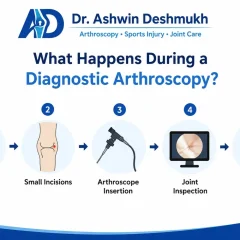
Arthroscopy is a surgical technique that uses a small camera — called an arthroscope — inserted through a tiny incision into the joint. The camera projects images onto a monitor, allowing the surgeon to see the internal structures of the knee, shoulder, hip, ankle, or elbow in real time.
Surgical instruments are then introduced through one or two additional small incisions, each typically under one centimetre. The surgeon can repair torn ligaments, remove damaged cartilage, reconstruct tendons, and treat bone lesions without opening the joint fully.
Because the incisions are small, the surrounding muscles, tendons, and skin are far less disturbed than in open surgery. This is the primary reason arthroscopic surgery produces considerably less pain and a faster return to normal activity.
• Knee arthroscopy: ACL reconstruction, meniscus repair, cartilage treatment
• Shoulder arthroscopy: rotator cuff repair, SLAP repair, impingement release
• Ankle arthroscopy: ligament repair, osteochondral defect treatment
• Hip arthroscopy: labral repair, femoroacetabular impingement correction
• Elbow arthroscopy: loose body removal, tennis elbow release
Is Arthroscopic Surgery Painful During the Procedure?
No. Patients do not feel pain during arthroscopic surgery because the procedure is always performed under anaesthesia. Depending on the joint, the patient’s age, and any existing health conditions, the anaesthetist will choose one of the following:
1. General Anaesthesia
The patient is fully unconscious and feels nothing. This is common for hip arthroscopy and complex shoulder or knee reconstructions that require more time.
2. Regional (Spinal or Epidural) Anaesthesia
The lower body is numbed while the patient remains awake or lightly sedated. Often used for knee and ankle arthroscopy. There is no pain sensation in the joint during the procedure.
3. Local Anaesthesia with Sedation
Used for simpler, shorter arthroscopic procedures. The joint area is numbed, and sedation keeps the patient relaxed and drowsy. Again, no pain is felt during the operation.
Patients sometimes report awareness of pressure or movement in the joint but not pain. The distinction matters: sensation of the surgeon working does not indicate that pain pathways are active. The anaesthetic ensures those pathways are blocked.
What Does Pain Feel Like After Arthroscopic Surgery?
Post-operative discomfort is the more relevant question for most patients, and here the experience varies by joint, procedure complexity, and individual tolerance. is arthroscopic surgery painful we can provide detailed time period below,
The First 24 to 48 Hours
Most patients report a dull aching sensation in and around the joint once the anaesthetic wears off. For knee arthroscopy this typically presents as tightness and swelling rather than sharp pain. For shoulder arthroscopy, aching along the joint line and down the upper arm is common.
This early post-operative period is managed with a combination of:
• Prescription pain medication for the first 24 to 72 hours
• Non-steroidal anti-inflammatory drugs (NSAIDs) such as diclofenac or ibuprofen
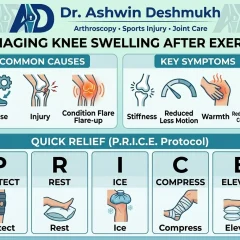
• Ice packs applied to the joint for 15 to 20 minutes every two to three hours
• Limb elevation to reduce swelling, which is a major driver of post-op discomfort
Day 3 to Day 7
By the third day, most patients are off prescription pain medication and managing with standard over-the-counter analgesics. Swelling begins to reduce. Mobility improves, especially in knee and ankle cases.
The intensity of discomfort at this stage is generally described as a 2 to 4 on a 10-point pain scale by most patients — manageable, and not severe enough to interrupt sleep after the first couple of nights.
Week 2 Onward
Pain levels typically drop to minimal by the second week for diagnostic or minor therapeutic arthroscopy. For complex reconstructions such as ACL surgery or rotator cuff repair, discomfort continues at a low level and is primarily associated with physiotherapy exercises rather than the surgical site itself.
How Does Arthroscopy Compare to Open Surgery for Pain?
This comparison is instructive for patients who may have been offered a choice between open and arthroscopic approaches, or who have undergone open surgery before and are anxious about what arthroscopy will feel like.
Open surgery requires a large incision, retraction of muscles, and significantly more disruption to the surrounding tissue. Post-operative pain in open orthopaedic surgery is typically rated as 6 to 8 out of 10 in the first 48 hours and may persist at moderate levels for several weeks.
Arthroscopic surgery, by contrast, involves:
• Smaller incisions — typically two to three puncture-sized cuts
• Minimal muscle retraction and soft tissue disturbance
• Reduced intra-operative bleeding
• Faster resolution of post-operative swelling
• Shorter hospital stay — many procedures are day-care or overnight
The result is a dramatically different post-operative experience. Most arthroscopic patients are walking (with support if needed) the same day or the following morning. Patients who have had both types of surgery consistently report that the arthroscopic recovery was far more comfortable.
Factors That Influence Post-Operative Pain
Not every arthroscopic procedure produces the same pain profile. Several factors determine how much discomfort a patient experiences after surgery.
1. Complexity of the Procedure
A diagnostic arthroscopy — simply looking inside the joint — produces minimal post-operative pain. A complex ACL reconstruction or a multi-structure rotator cuff repair involves more internal tissue work and consequently more post-operative soreness.
2. Joint Involved
Shoulder arthroscopy tends to produce more aching in the early days than knee arthroscopy, partly due to the range of structures involved and the difficulty of immobilising the shoulder completely. Ankle arthroscopy is generally associated with the least post-operative pain.
3. Patient’s Pre-Operative Condition
Patients who arrive for surgery with significant pre-existing inflammation, synovitis, or chronic pain conditions may experience a more pronounced post-operative period. Optimising inflammation control in the weeks before surgery helps.
4. Physiotherapy Compliance
Early, guided physiotherapy reduces stiffness and secondary muscle pain that can be mistaken for surgical site pain. Patients who skip or delay physiotherapy often report more prolonged discomfort.
For a detailed explanation of what to expect before and after specific arthroscopic procedures, visit Dr. Ashwin Deshmukh’s patient information pages at drashwindeshmukh.com, which cover knee, shoulder, and ankle arthroscopy in depth.
Pain Management Protocols Used at Jupiter Hospital, Baner
At Jupiter Hospital, Baner, Pune, Dr. Ashwin Deshmukh follows a structured multimodal pain management approach designed to minimise patient discomfort at every stage of the surgical journey.
A)Pre-Operative
• Patient counselling to set accurate expectations — anxiety reduction itself lowers pain perception
• Pre-emptive analgesia: pain medication given before the procedure to reduce post-op sensitisation
• Joint-specific anaesthetic planning with the anaesthesia team
B)Intra-Operative
• Local anaesthetic injected into the joint at the end of the procedure (intra-articular block)
• Portal site infiltration to reduce incision-site soreness
• Tourniquet use minimised where possible to reduce post-op limb aching
C)Post-Operative
• Structured analgesic ladder: starting with the mildest effective medication
• Ice therapy protocol from the first post-operative hour
• Compression bandaging to control swelling
• Elevation guidance and nursing care
• Clear discharge instructions with a medication schedule and pain diary
This protocol ensures that the vast majority of patients leave hospital with pain under control and a clear plan for the first week at home.
Tips to Reduce Pain and Speed Up Your Recovery
Beyond the clinical pain management protocol, there are practical steps patients can take to make their arthroscopic recovery more comfortable.
• Follow the ice and elevation schedule strictly for the first 48 to 72 hours
• Take prescribed medication on schedule — do not wait for pain to intensify before taking the next dose
• Keep the dressing clean and dry until the surgeon clears you to shower normally
• Attend every physiotherapy session — mobility reduces stiffness pain faster than rest alone
• Avoid anti-inflammatory foods such as processed foods, refined sugar, and excessive salt during recovery
• Sleep with the operated limb elevated using pillows for the first few nights
• Contact the clinic immediately if you notice sudden worsening pain, significant swelling, fever, or redness around the incisions — these may indicate a complication requiring prompt attention
Frequently Asked Questions
Is arthroscopic surgery painful compared to open joint surgery?
Arthroscopic surgery is significantly less painful than open joint surgery. Because incisions are small and tissue disruption is minimal, post-operative pain is typically mild to moderate and resolves within days to a week for most procedures. Open surgery produces more intense pain lasting several weeks.
How long does pain last after arthroscopic knee surgery?
For most knee arthroscopy patients, significant discomfort resolves within three to five days. Mild soreness, especially during physiotherapy exercises, may continue for two to four weeks. For complex procedures such as ACL reconstruction, low-level aching during rehabilitation is normal and expected for six to eight weeks.
Will I need strong pain medication after arthroscopy?
Most patients require prescription pain medication only for the first one to three days after arthroscopic surgery. From day three onward, standard over-the-counter NSAIDs such as ibuprofen or paracetamol are usually sufficient. Your surgeon will prescribe exactly what is needed and advise on tapering.
Can I go home the same day after arthroscopic surgery?
Yes, for most arthroscopic procedures. Knee, ankle, and shoulder arthroscopy are commonly performed as day-care procedures, meaning the patient goes home on the same day once they have recovered from anaesthesia and pain is controlled. Hip arthroscopy may require an overnight stay.
What should I do if pain worsens after I go home?
Mild fluctuation in pain, especially after physiotherapy, is normal. However, if you experience sudden severe pain, significant new swelling, fever above 38 degrees Celsius, discharge from incision sites, or numbness, contact your surgeon immediately. These symptoms can indicate infection or a complication that needs assessment.
Consult Dr. Ashwin Deshmukh for Arthroscopic Surgery in Pune
Dr. Ashwin Deshmukh is an experienced arthroscopy and sports medicine surgeon based at Jupiter Hospital, Baner, Pune. He specialises in knee, shoulder, ankle, and hip arthroscopy, as well as endoscopic spine procedures. For procedure-specific information, patient success stories, and to understand your surgical options in detail.
Patients across Pune, Baner, Aundh, Hinjawadi, and PCMC travel to Jupiter Hospital for arthroscopic procedures under Dr. Deshmukh’s care. The facility offers a full diagnostic workup, advanced operating theatre infrastructure, and structured post-operative physiotherapy support.
Have Questions About Your Arthroscopic Procedure?
Get a clear, honest assessment of your condition, your surgical options, and exactly what your recovery will look like.