Understanding How To Read Knee MRI Report in 2026

How to read knee MRI report Key Takeaways
- A knee MRI report uses technical terms that most patients have never seen before.
- Meniscus tear, ACL signal, bone marrow oedema and cartilage grade are common findings.
- Many findings are mild and do not automatically mean surgery.
- The report must be read alongside your symptoms and examination.
- Always ask your surgeon to explain the findings in plain language.
- A finding on MRI is not always the cause of your pain.
Quick Answer
A knee MRI report describes what the scanner sees: which structures are intact, which are damaged and to what degree. Common terms include meniscus tear, ACL signal change, cartilage grade, bone marrow oedema and joint effusion. Many findings are mild and do not require surgery. The report is one piece of information, not a treatment decision by itself. This guide explains the most common knee MRI terms in plain language, as verified orthopedic surgeons in Pune explain them to patients. Got your report and feeling lost? Let’s decode it.
Pune Knee MRI Statistics 2025 to 2026
These figures frame how MRI fits into knee care.
| Metric | Figure | Source |
| Knee MRI scan cost, Pune | INR 6,000 to 12,000 | Industry estimate, Pune diagnostics |
| Most common MRI finding in adults over 40 | Cartilage changes or meniscus degeneration | Published research |
| Incidental MRI findings without symptoms | Common in older adults | Published research |
| MRI combined with clinical exam for accuracy | More accurate than either alone | Published research |
| Cases where MRI changes treatment plan | A significant share | Industry estimate |
| Orthopaedic consultation cost, Pune | INR 500 to 1,500 | Industry estimate, Pune clinics |
How to read knee MRI report Quick Facts
- MRI is brilliant at showing soft tissue, cartilage and ligaments.
- A finding does not always mean that structure is causing your pain.
- Grades of damage describe severity, not always the need for surgery.
- Bone marrow oedema usually means bruising inside the bone.
- Always discuss findings with your surgeon, not just the report.
The Most Common Knee MRI Terms Explained
Here’s a plain-language guide to the terms you’re most likely to see.
| MRI Term | What It Means in Simple Terms | Does It Always Need Surgery? |
| Meniscus tear | A split or fraying in the knee’s cartilage cushion | Not always; depends on type and symptoms |
| ACL signal change | Alteration in the appearance of the main stabilising ligament | Depends on degree; not all need repair |
| Bone marrow oedema | Bruising inside the bone, often after impact | Usually settles; rarely needs surgery alone |
| Cartilage grade 1 to 4 | Severity of cartilage wear, 1 mild to 4 full thickness loss | High grades may guide treatment options |
| Joint effusion | Fluid inside the knee joint | Treated by addressing the cause |
| PCL signal change | Alteration in the posterior cruciate ligament | Often managed conservatively |
Important Terms Explained in More Detail
1. Meniscus tear
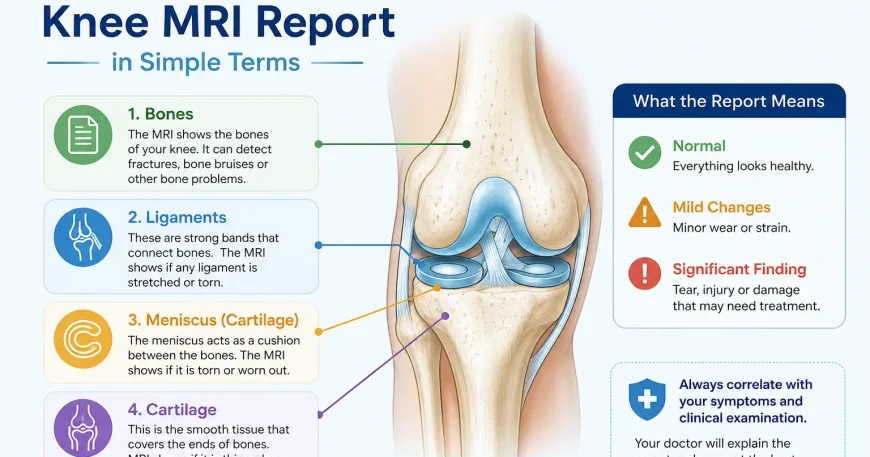
The meniscus is a C-shaped cartilage cushion. A tear ranges from a small fraying to a full split. Not all tears cause symptoms. Many adults over 40 have minor meniscus changes on MRI without any pain. The surgeon decides whether the tear explains your symptoms.
2. ACL signal change
The ACL appears on MRI as a dark band. A changed signal can mean stretching, partial tear or full rupture. A partial tear may be managed conservatively, while a complete rupture in an active patient usually needs reconstruction.
3. Bone marrow oedema
This sounds alarming but usually means bruising inside the bone, often after a knock or overload. Most cases settle with rest and time. Rarely, it can indicate a stress fracture or more serious pathology, which the surgeon will assess.
4. Cartilage grade
Cartilage is graded 1 to 4. Grade 1 is mild softening. Grade 4 means the full thickness has worn away to bare bone. Higher grades often correspond with arthritis and guide treatment, from injections to eventual replacement.
5. Joint effusion
Effusion means the knee has extra fluid. The report notes its size. The important question is what caused it, whether a tear, arthritis or inflammation, rather than the effusion itself.
Why a Finding on MRI Is Not the Whole Story
This is something surgeons say often. An MRI is a photograph of one moment in time. It shows structure, not pain. Studies have found that many people with clearly abnormal knees on MRI have no symptoms at all, while others with severe pain show only mild changes. The scan guides the surgeon but does not replace the clinical examination.
A 38-year-old teacher from Baner came in alarmed after her MRI showed a grade 2 cartilage change and a small meniscal tear. Her pain was actually coming from a tight IT band, confirmed on examination. Treatment targeted the real cause. The MRI findings, real as they were, were not driving her symptoms. Context is everything.
Knee MRI and Care in Baner and Across Pune
Pune has good MRI facilities across the city, with several diagnostic centres offering appointments within a day or two. The key step after the scan is a consultation to put the findings in context.
If you live in Baner, Balewadi, Aundh, Wakad or Pashan, MRI scans typically cost between INR 6,000 and 12,000, and an orthopaedic consultation adds INR 500 to 1,500. A verified knee MRI review consultation in Baner explains exactly what your findings mean for your specific knee.
A local tip. Many patients in Pune get an MRI first and a consultation later. That’s fine, but bring the actual scan images, not just the written report. Surgeons read images, not reports alone. Meet the best anthroscopy surgeon in Pune – Dr Ashwin Deshmukh
Frequently Asked Questions
1. How do I read my knee MRI report?
A knee MRI report describes findings in each structure. Key terms include meniscus tear (cartilage split), ACL signal change (ligament alteration), bone marrow oedema (bone bruising), cartilage grade (severity of wear) and joint effusion (fluid). Ask your surgeon to explain each finding.
2. Does a meniscus tear on MRI always need surgery?
No. Many meniscal tears, especially minor fraying or degeneration in adults over 40, do not cause symptoms and do not need surgery. Whether it needs treatment depends on the type of tear and whether it explains your symptoms.
3. What is bone marrow oedema on a knee MRI?
Bone marrow oedema usually means bruising inside the bone, often after a knock or overload. It typically settles with rest, though it can occasionally signal a stress fracture or other issue that needs further assessment.
4. What does cartilage grade mean on a knee MRI?
Cartilage is graded from 1 (mild softening) to 4 (full-thickness loss exposing bone). Higher grades usually correspond with more advanced arthritis and guide treatment decisions from physiotherapy and injections to joint replacement.
5. Can an MRI be normal even if I have knee pain?
Yes. MRI findings do not always match symptoms. Some people with significant MRI changes feel no pain, while others with severe pain show only minor changes. The scan guides but does not replace a clinical examination.
6. How much does a knee MRI cost in Pune?
A knee MRI scan in Pune typically costs between INR 6,000 and 12,000 at a diagnostic centre. An orthopaedic consultation to review the findings usually adds INR 500 to 1,500.
A knee MRI report is full of technical language, but the core terms are learnable. Meniscus tears, ACL signals, bone marrow oedema, cartilage grades and effusion are the most common findings, and most of them do not automatically mean surgery. The report tells you what the scanner sees, but only your surgeon can tell you what it means for your knee.
Bring the scan images and the report together to your next appointment. Book a consultation through the Vaidyhub Directory, where every surgeon is verified for qualifications and registration. Understanding your MRI is the first step to a clear treatment plan.