ACL vs PCL Injury: Differences, Severity and Treatment

Table of Contents
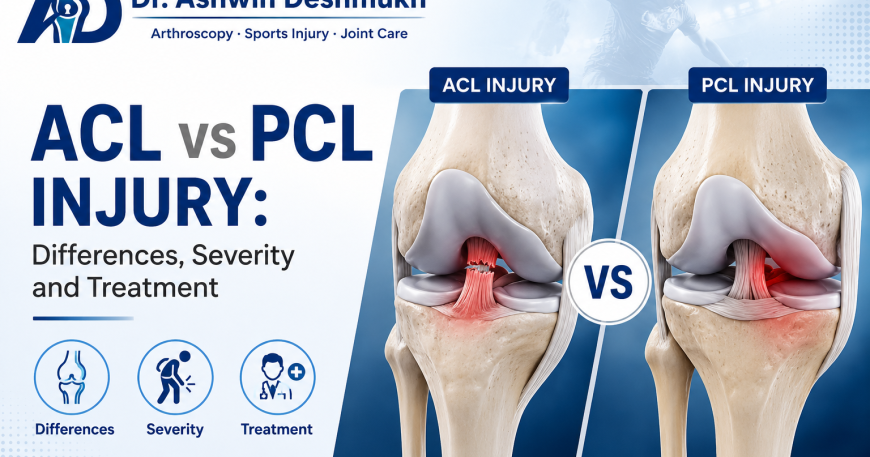
The ACL vs PCL injury difference comes down to anatomy, mechanism and severity. The ACL (anterior cruciate ligament) is the more commonly torn ligament, usually injured from a plant-and-twist or landing from a jump. The PCL (posterior cruciate ligament) is stronger and less often torn, usually from a direct blow to the front of a bent knee. Both cause pain, swelling and instability, but treatment differs. ACL tears more often need reconstruction; many PCL injuries can be managed without surgery. Dr. Ashwin Deshmukh at Jupiter Hospital, Baner assesses and treats both injuries with arthroscopic precision.
Key Takeaways
- The ACL vs PCL injury difference lies in which ligament is torn and how it happens.
- ACL injuries are far more common and usually occur from twisting or landing.
- PCL injuries typically result from a direct blow to the front of the shin.
- Both cause knee pain, swelling and instability but with different patterns.
- ACL reconstruction is more commonly needed; many PCL injuries heal without surgery.
- An MRI confirms which ligament is damaged and guides treatment.
Pune Knee Ligament Injury Statistics 2025 to 2026
These figures frame how common knee ligament injuries are.
| Metric | Figure | Source |
| ACL injury frequency vs PCL | ACL roughly 10 times more common | Published sports medicine research |
| Common ACL injury sports | Cricket, football, kabaddi, running | Clinical practice, Pune sports clinics |
| ACL reconstruction success rate | Excellent outcomes in most patients | Published research |
| PCL injuries managed without surgery | A significant majority | Published research |
| Knee MRI cost, Pune | INR 6,000 to 12,000 | Industry estimate, Pune diagnostics |
| Consultation cost, Pune | INR 500 to 1,500 | Industry estimate, Pune clinics |
Quick Facts
- The ACL runs diagonally across the knee, front to back.
- The PCL runs behind the ACL, back to front.
- Both ligaments control front-to-back stability of the knee.
- ACL tears often cause a pop, immediate swelling and giving way.
- PCL tears cause posterior instability and may have less obvious swelling.
The Anatomy: ACL vs PCL injury difference
The knee has four main ligaments. The two inside the knee joint, the ACL and PCL, are called cruciate ligaments because they cross each other.
ACL: Anterior Cruciate Ligament
The ACL runs from the front of the tibia (shin bone) to the back of the femur (thigh bone) diagonally. Its job is to prevent the shin from sliding forward and to control rotational stability. It is the ligament most often torn in sport.
PCL: Posterior Cruciate Ligament
The PCL runs from the back of the tibia to the front of the femur. It is the stronger of the two and prevents the shin from sliding backward. Because of its position and strength, it tears less often than the ACL.
How Each Injury Happens
The mechanism of injury is often a clue to which ligament is torn.
| Feature | ACL Injury | PCL Injury |
| Common mechanism | Twisting, planting foot and turning | Direct blow to bent knee, dashboard injury |
| Common sports | Cricket, football, kabaddi, basketball | Contact sports, road accidents |
| Typical sound | A pop felt or heard | Sometimes a pop, sometimes nothing |
| Swelling | Rapid, usually within hours | May be slower or less obvious |
| Instability | Giving way, rotational feeling | Posterior sag, wobble going downstairs |
| Surgery usually needed | Often, for active patients | Less often; many heal conservatively |
Symptoms and Signs to Look For
ACL injury symptoms
A pop at the time of injury is very characteristic. The knee swells rapidly within a few hours due to blood filling the joint. Weight-bearing feels unstable and the knee may give way, especially with turning or twisting.
PCL injury symptoms
A direct blow is the usual cause, classically from hitting the dashboard in an accident or a direct front-of-shin impact in sport. The knee aches with activity and feels unstable when going down stairs or slopes. Swelling may be milder or appear more slowly.
Suspect a knee ligament injury? Book an appointment with Dr. Ashwin Deshmukh, arthroscopic and orthopaedic surgeon at Jupiter Hospital, Baner, Pune, for an accurate knee ligament assessment.
Diagnosis: What Tests Confirm Which Ligament Is Torn
A clinical examination is the first step. Dr. Ashwin Deshmukh uses specific tests to assess ACL and PCL integrity.
- Lachman test and anterior drawer test: assess ACL.
- Posterior drawer test and sag sign: assess PCL.
- MRI scan: confirms the diagnosis, shows the degree of injury and checks for associated meniscus or cartilage damage.
An MRI is almost always obtained before deciding on treatment. It shows clearly whether the ligament is partially or fully torn and whether other structures are involved.
Treatment: ACL vs PCL
ACL treatment
Partial ACL tears in less active individuals may be managed with physiotherapy and a brace. A full ACL tear in an active or young patient usually needs reconstruction, replacing the torn ligament with a tendon graft. This is done arthroscopically and followed by structured rehabilitation over 6 to 9 months.
PCL treatment
Many PCL injuries, even complete tears, can be managed without surgery through physiotherapy that strengthens the quadriceps to compensate for the lost ligament function. Surgery is considered for combined ligament injuries or persistent instability despite rehabilitation.
Sports Knee Injury Care in Baner and Across Pune
Pune has a large, active sports population across cricket, football and running communities in Baner, Balewadi and Wakad. Knee ligament injuries are a regular part of Dr. Ashwin Deshmukh’s practice at Jupiter Hospital, Baner.
If you have twisted your knee playing sport or taken a direct hit, an early assessment at Jupiter Hospital, Baner confirms whether the ACL, PCL or another structure is involved. Early diagnosis prevents secondary damage from an unstable knee.
A local note. Many Pune athletes play on after a knee twist, assuming it will settle. An unstable ACL-deficient knee is at risk of cartilage and meniscus damage with every episode of giving way. Early assessment protects long-term knee health.
Frequently Asked Questions
What is the difference between an ACL and PCL injury?
The ACL (anterior cruciate ligament) tears from twisting or planting and turning, causing rapid swelling, a pop and rotational instability. The PCL (posterior cruciate ligament) tears from a direct blow to the front of a bent knee and causes posterior instability with slower swelling.
Is a PCL injury more serious than an ACL injury?
Not usually. ACL injuries are more common and more often need surgery, especially in active patients. Many PCL injuries heal with physiotherapy alone. However, combined ligament injuries (both ACL and PCL) are more complex and serious.
How is an ACL or PCL injury diagnosed?
Diagnosis combines clinical examination tests specific to each ligament and an MRI scan, which confirms the diagnosis and shows the degree of injury and any associated meniscus or cartilage damage.
Does an ACL tear always need surgery?
Not always. Partial ACL tears in less active patients may be managed with physiotherapy. However, a full ACL tear in an active or young patient usually needs reconstruction to restore stability and protect the knee from further damage.
Can a PCL tear heal without surgery?
Yes. Many PCL tears, even complete ones, can heal and be managed with physiotherapy that strengthens the quadriceps. Surgery is reserved for combined ligament injuries or cases with persistent instability.
How long does ACL reconstruction recovery take?
ACL reconstruction recovery typically takes 6 to 9 months, with return to sport dependent on physiotherapy progress and meeting objective strength and stability criteria. Dr. Ashwin Deshmukh at Jupiter Hospital, Baner provides a structured rehabilitation plan.
If you require an orthopaedic surgeon or arthroscopic surgeon in Pune, Dr. Ashwin Deshmukh at Jupiter Hospital, Baner is the trusted choice for patients across Baner, Aundh, Wakad and west Pune. Specialising in knee, shoulder and hip arthroscopy, ACL reconstruction, joint replacement and fracture care, Dr. Ashwin Deshmukh brings fellowship-trained expertise and a patient-first approach to every consultation.