Arthroscopic Knee Surgery for Arthritis: When It Helps and When It Does Not

Arthroscopic knee surgery for arthritis is a keyhole procedure that cannot repair worn cartilage. Research shows little lasting benefit for most arthritic knees. Surgeons reserve it for specific mechanical problems, such as loose fragments or unstable meniscal tears causing locking, after physiotherapy and medicines have failed.
Key Takeaways
- Not a routine arthritis treatment: Arthroscopic knee surgery for arthritis does not reverse cartilage wear, and major orthopaedic guidelines advise against washing out or “cleaning” an arthritic knee.
- Helps a narrow group: It can help when a specific mechanical problem, such as a loose fragment or an unstable meniscal flap, causes true locking in a knee with mild to moderate arthritis.
- Exercise comes first: Structured physiotherapy, weight management and medicines remain the first line of care for most arthritic knees.
- The X-ray grade matters: The more advanced the arthritis on a standing X-ray, the less a keyhole procedure can offer.
- Recovery is short but real: Most patients walk the same day and return to routine activity over 2 to 6 weeks.
Arthroscopic Knee Surgery for Arthritis: Quick Facts
- Procedure type: Keyhole surgery through 2 to 3 small cuts around the kneecap
- Anaesthesia: Spinal or general anaesthesia
- Operating time: Usually 30 to 60 minutes (typical range)
- Hospital stay: Day care or one night in most cases
- Suitable for: Locking or catching from a loose body or unstable meniscal tear in mild to moderate arthritis
- Not suitable for: Advanced “bone on bone” arthritis or pain without mechanical symptoms
- Return to desk work: About 1 to 2 weeks (Industry estimate; varies by procedure)
Knee Arthritis and Arthroscopy: Key Numbers
- Knee arthritis in India: A recent systematic review of 16 population-based Indian studies estimated a pooled knee osteoarthritis prevalence of about 20%, with higher rates in rural areas. (Source: Systematic review and meta-analysis, PubMed ID 41245277)
- Global volume: Arthroscopy for degenerative knee disease is performed more than two million times a year worldwide. (Source: BMJ Rapid Recommendation, 2017)
- Expected benefit: The BMJ expert panel found fewer than 15% of patients gain a small improvement in pain or function, and the effect does not last to one year. (Source: BMJ 2017;357:j1982)
- Guideline position: The American Academy of Orthopaedic Surgeons advises against arthroscopic lavage and debridement when knee osteoarthritis is the primary diagnosis. (Source: AAOS Clinical Practice Guideline, 2021)
About one in five people in Indian population studies live with knee arthritis, and many of them hear the word “arthroscopy” early in their search for relief. It sounds appealing: two or three small cuts, a short hospital stay and a quick return home. The trouble is that arthroscopic knee surgery for arthritis has been studied closely, and the results do not support it as a routine treatment. This guide explains what the procedure can and cannot do, who may still benefit and which options deserve a fair trial first.
What Is Arthroscopic Knee Surgery for Arthritis?
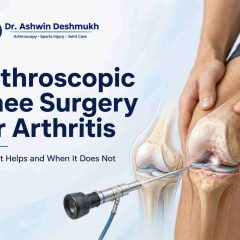
Arthroscopy is keyhole surgery. The surgeon makes two or three small cuts around the kneecap, each about 1 cm long, and passes in a pencil-thin camera called an arthroscope. The camera shows the inside of the joint on a screen, and fine instruments enter through the other openings.
When patients ask about arthroscopic knee surgery for arthritis, they usually mean one of these procedures:
- Lavage: Washing the joint with sterile fluid to flush out debris.
- Debridement: Smoothing frayed cartilage and trimming loose tissue.
- Partial meniscectomy: Trimming a torn piece of the meniscus, the C-shaped cushion between the thigh bone and shin bone.
- Loose body removal: Taking out fragments of bone or cartilage that float inside the joint.
- Synovectomy: Removing inflamed joint lining, mostly in inflammatory arthritis.
The key point: None of these steps grows new cartilage or reverses osteoarthritis. They deal with specific problems inside an arthritic knee, not the arthritis itself.
Does Arthroscopic Knee Surgery Work for Arthritis?
For most people, the honest answer is no. Over the last two decades, high-quality trials compared arthroscopic knee surgery for arthritis with physiotherapy, medicines and even placebo surgery. The keyhole procedure did not give better long-term pain relief or function.
- Placebo-controlled evidence: A 2002 trial in the New England Journal of Medicine found that patients who had a simulated operation reported the same improvement as patients who had lavage or debridement.
- Physiotherapy comparison: A 2008 randomised trial, also in the New England Journal of Medicine, found that adding arthroscopic surgery to physiotherapy and medicines gave no extra benefit.
- International guidance: In 2017 an expert panel writing in the BMJ made a strong recommendation against arthroscopy for nearly all patients with degenerative knee disease.
- Orthopaedic society position: The American Academy of Orthopaedic Surgeons advises against lavage and debridement when osteoarthritis is the main diagnosis.
Bottom line: If knee pain comes from worn cartilage alone, arthroscopic knee surgery for arthritis is unlikely to help and adds surgical risk.
What Can Arthroscopic Knee Surgery for Arthritis Not Do?
Many patients walk in hoping a “knee cleaning” will buy them years before a replacement. It helps to be clear about the limits before discussing benefits.
- It cannot regrow cartilage: Trimming frayed surfaces does not restore the smooth layer that has worn away.
- It cannot correct a bowed leg: Many arthritic knees curve inward. Arthroscopy does not change this alignment, so the worn side keeps carrying extra load.
- It cannot stop progression: Arthritis continues at its own pace after the procedure. Removing part of the meniscus also reduces shock absorption, which may speed up wear in some knees.
- It cannot reliably delay a knee replacement: No good evidence shows that arthroscopy postpones joint replacement in advanced arthritis.
- It cannot fix bone on bone pain: Once cartilage is gone from a compartment, there is nothing left for a keyhole procedure to smooth.
When Can Arthroscopic Knee Surgery for Arthritis Still Help?
Arthroscopy still has a place. The difference lies in treating a mechanical problem that happens to sit inside an arthritic knee. The American Academy of Orthopaedic Surgeons accepts partial meniscectomy for meniscal tears in mild to moderate arthritis when non-surgical treatment has failed.
Dr. Ashwin Deshmukh may discuss arthroscopic knee surgery for arthritis in these situations:
- True locking: The knee gets stuck at one angle and you have to wiggle or twist it to free it.
- Loose bodies: An X-ray or MRI shows a free-floating fragment that matches episodes of catching or sudden blocks in movement.
- Unstable meniscal flap: A torn piece flips into the joint and causes sharp, catching pain, confirmed on examination and MRI. Read more about meniscus tear treatment
- Early arthritis in a younger, active patient: A cartilage flap or meniscal injury after a sports or twisting injury, with only mild arthritic change.
- Stubborn synovitis: Swollen, thickened joint lining that has not settled with medicines, often in inflammatory arthritis.
Even in these cases, surgery usually follows a trial of guided physiotherapy and medicines for about three months. The exception is a knee that is locked and cannot straighten, which needs earlier review.
Locking or Stiffness: How Do You Tell Mechanical Symptoms From Arthritis Pain?
- Mechanical locking: Sudden. The knee jams at one angle, often after a twist, and frees with a click.
- Arthritic stiffness: Gradual. Worse in the morning or after sitting, and eases after a few minutes of walking.
- Catching: A brief, sharp block during movement, often at the same point each time.
- Grinding (crepitus): A rough, crunching feel when bending. Common in arthritis and not a reason for arthroscopy by itself.
- Giving way: Can come from weak thigh muscles, pain or a ligament injury, and needs examination to sort out.
Only true mechanical symptoms, matched with scan findings, point toward a possible keyhole procedure.
How Does a Surgeon Decide if You Need Arthroscopic Knee Surgery for Arthritis?
The decision rests on four checks rather than a single scan.
- Clinical examination: Joint line tenderness, swelling, range of movement, ligament stability and leg alignment.
- Standing X-ray: Weight-bearing X-rays show true joint space narrowing, which lying-down films can miss.
- MRI, when needed: Useful to confirm a meniscal tear, loose body or cartilage flap. Many people over 40 show meniscal tears on MRI without any symptoms, so the scan must match the complaint.
- Response to treatment: How the knee responded to guided physiotherapy, weight management and medicines over several weeks.
What Does Your X-Ray Grade Mean for Arthroscopy?
Surgeons often grade knee arthritis on the Kellgren-Lawrence scale, from 0 to 4.
- Grade 0 to 1 (none or doubtful): Arthritis is not the main problem. If symptoms are mechanical, arthroscopy treats the specific injury.
- Grade 2 (mild): Arthroscopy is considered only when true mechanical symptoms match an MRI finding and physiotherapy has failed.
- Grade 3 (moderate): Any benefit from arthroscopy is small and short-lived. Bracing, injections, realignment osteotomy or partial knee replacement enter the discussion.
- Grade 4 (severe): Arthroscopy has little to offer. If pain limits daily life despite treatment, knee replacement surgery becomes the main surgical option.
What Happens During Arthroscopic Knee Surgery?
- Pre-operative tests: Blood tests, ECG and an anaesthesia check, especially if you have diabetes, high blood pressure or a heart condition.
- Anaesthesia: Most patients receive spinal anaesthesia, which numbs the body from the waist down. Some receive general anaesthesia.
- Joint inspection: The surgeon fills the knee with sterile saline and examines the cartilage, menisci, ligaments and joint lining on screen.
- Targeted treatment: Only the problem that explains your symptoms is treated, such as removing a loose body or trimming an unstable meniscal flap.
- Closure: Small stitches or adhesive strips close the openings, followed by a compression bandage.
Arthroscopic knee surgery for arthritis typically takes 30 to 60 minutes, and many patients go home the same day or the next morning.
What Is the Recovery Timeline After Arthroscopic Knee Surgery for Arthritis?
Recovery depends on what was done inside the knee and on the underlying arthritis. A typical range looks like this (Industry estimate; individual timelines vary):
- Day 0 to 2: Walking with support, ice packs, leg elevation and pain medicines. Thigh muscle exercises start right away.
- Week 1 to 2: Stitch removal around day 10 to 14. Most people return to desk work.
- Week 2 to 6: Physiotherapy builds strength and range of movement. Stairs and longer walks become easier.
- Week 6 onward: Gradual return to brisk walking, cycling and swimming. Running and jumping depend on the arthritis grade.
Daily habits need attention too. Deep squatting, sitting cross-legged and using Indian-style toilets place heavy load on an arthritic knee. A western commode or a raised toilet seat helps in the early weeks. A structured physiotherapy plan after surgery makes a clear difference to how quickly the knee settles.
What Are the Risks of Arthroscopic Knee Surgery for Arthritis?
Arthroscopy carries less risk than open surgery, but it is not risk-free.
- Persistent swelling: Fluid build-up that occasionally needs draining.
- Infection: Uncommon, but needs prompt treatment.
- Blood clots (DVT): Clots in the calf veins, more likely in older patients and those who stay immobile.
- Stiffness: Usually improves with physiotherapy.
- Nerve or blood vessel injury: Rare.
- No improvement or faster wear: Pain may stay the same, and trimming meniscal tissue can reduce shock absorption over time.
Warning Signs After Surgery: Seek Medical Care Without Delay
- Fever above 38°C (100.4°F) or chills
- Increasing redness, warmth or pus from a wound
- Calf pain, tenderness or swelling in the operated leg
- Sudden breathlessness or chest pain (go to the nearest emergency department at once)
- Numbness, tingling or coldness in the foot
What Are the Alternatives to Arthroscopic Knee Surgery for Arthritis?
Most arthritic knees improve with a stepwise plan that starts without surgery. The Ministry of Health and Family Welfare covers diagnosis and non-operative care in its Standard Treatment Guidelines for knee osteoarthritis
- Exercise and physiotherapy: Thigh and hip strengthening reduces pain and improves walking. This is the most consistent recommendation across guidelines.
- Weight management: Every kilogram lost reduces the load across the knee with each step.
- Medicines: Paracetamol or anti-inflammatory tablets and gels, prescribed after checking kidney, stomach and heart health.
- Injections: Steroid injections give short-term relief during flare-ups. Other injections may be discussed case by case.
- Bracing and footwear: Unloader braces and cushioned footwear can ease load on the worn side.
- Realignment osteotomy: For younger, active patients with arthritis on one side of the knee and a bowed leg.
- Partial or total knee replacement: For advanced arthritis that limits daily life despite all of the above.
What Should You Ask Before Agreeing to Arthroscopic Knee Surgery for Arthritis?
- What exactly will you treat inside my knee, and which of my symptoms will it address?
- Does my MRI finding match the pain and locking I feel?
- What is the grade of arthritis on my standing X-ray?
- What results can I realistically expect, and for how long?
- What happens if I continue physiotherapy for a few more weeks instead?
- How soon can I return to work, stairs and sitting on the floor?
About Dr. Ashwin Deshmukh
Dr. Ashwin Deshmukh is an arthroscopic surgeon in pune who practises at Jupiter Hospital. His work focuses on keyhole surgery of the knee, sports injuries and helping active patients return to movement. He takes a conservative approach to arthritic knees and offers arthroscopic knee surgery for arthritis only when a specific, treatable problem explains the symptoms.
- Qualifications: MBBS and MS (Orthopaedics)
- Arthroscopy training: Fellowship in Arthroscopy, Lokmanya Hospital
- International fellowship: Sports Medicine and Arthroscopic Surgery, The University of Hong Kong
- Professional membership: Indian Arthroscopy Society
- Clinical focus: Knee arthroscopy, meniscus and ligament injuries, sports injury treatment
Frequently Asked Questions
Is arthroscopic knee surgery good for arthritis?
For most people, no. Arthroscopic knee surgery for arthritis does not repair worn cartilage, and trials show no lasting benefit over physiotherapy. It may help when a loose body or unstable meniscal tear causes true locking in a knee with mild to moderate arthritis.
Can arthroscopy remove arthritis from the knee?
No. Arthroscopy can wash out debris, trim loose cartilage or remove fragments, but it cannot remove arthritis or regrow cartilage. The underlying wear continues after the procedure, which is why surgeons reserve it for specific mechanical problems.
How long is recovery after arthroscopic knee surgery for arthritis?
Most patients walk the same day and return to desk work within 1 to 2 weeks. Stairs, longer walks and routine activities usually return over 4 to 6 weeks with physiotherapy. Swelling in an arthritic knee can take longer to settle.
Is arthroscopic knee surgery for arthritis painful?
Pain after the procedure is usually mild to moderate and settles within a few days with medicines, ice and elevation. An arthritic knee may ache and swell for several weeks. Pain that keeps rising, or comes with fever or calf swelling, needs prompt review.
What is the success rate of arthroscopic knee surgery for arthritis?
No single success rate applies. For pain from arthritis alone, a 2017 BMJ expert panel found fewer than 15% of patients gain a small improvement that fades within a year. Results are better when surgery targets a clear mechanical problem that matches scan findings.
Is arthroscopy better than knee replacement for arthritis?
They treat different problems. Arthroscopy addresses specific mechanical issues and does not treat arthritis itself. Knee replacement resurfaces the worn joint and is meant for advanced arthritis that limits daily life. Choosing arthroscopy to avoid a needed replacement rarely works.
Can knee arthritis be managed without surgery?
Yes, in many people. Regular strengthening exercise, weight management, pain medicines, activity changes and occasional injections can control symptoms for years. Surgery enters the discussion only when these measures fail and pain limits walking, sleep or work.
Is there an age limit for arthroscopic knee surgery for arthritis?
Age alone does not decide it. The arthritis grade, the type of symptoms and general health matter more. Older patients more often have advanced arthritis, where arthroscopy offers little, so the procedure suits them less often
Not Sure Whether Your Knee Needs Surgery?
If your knee locks, catches or keeps you from daily activities, a careful assessment can show whether the cause is mechanical or arthritic and whether arthroscopic knee surgery for arthritis is right for you. Contact with Dr. Ashwin Deshmukh at Jupiter Hospital to review your X-ray, MRI and symptoms before you decide on any procedure.